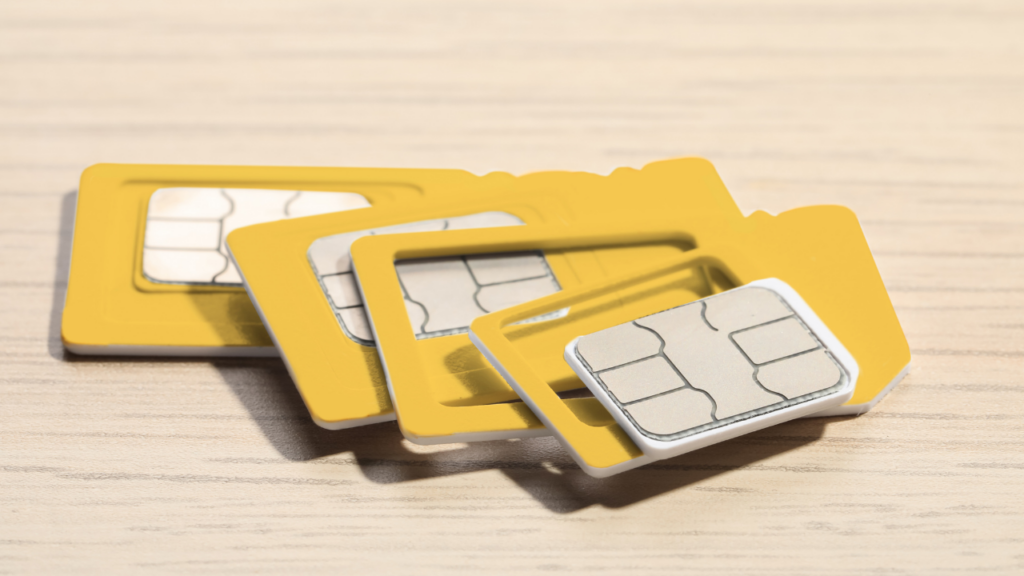
MVNOs have had a significant impact on the mobile market, providing more options for the consumers.
Not everyone knows that the UK mobile market is one of the most competitive in the world, with four major network operators (EE, O2, Vodafone and Three) and over 30 MVNOs competing for customers on price and high-quality service to retain customers. The UK telecom market is also highly regulated regarding network sharing and number portability, which creates an additional barrier for new and existing players. The fact that MVNOs are still evolving in the UK proves that this concept is not outdated but is getting a new meaning. The growing popularity of an #eSIM is not the only trend reshaping the mobile market. Let’s investigate it.
Beginning of the MVNO era
Thanks to eSIM, users no longer need to physically swap out SIM cards when they switch carriers or travel to a different country. Instead, they can download a new carrier profile onto their device.
The concept of MVNOs first emerged in the late 1990s when the mobile telecommunications industry was starting to mature. At the time, mobile network operators were building out their infrastructure and struggling to attract customers to the extensive cost of mobile service. The new idea of reimbursing their investment in the network arose. Smaller telecom companies could enter the market and purchase network capacity from the MNOs. The first MVNOs were launched in Europe in the early 2000s, and they quickly gained popularity, offering mobile services. In the UK, Virgin Mobile, founded by Richard Branson’s Virgin Group, became the first #MVNO to launch in 1999, using the One2One network (now T-Mobile UK). Virgin Mobile rapidly gained an impressive customer base by offering competitive pricing and new services. Other MVNOs soon followed, and by the mid-2000s, there were dozens of them operating across Europe.
In Belgium, it all started with the launch of BASE in 2004 under the brand name “JIM Mobile,” targeting the young generation with affordable mobile plans. The Belgian telecom market had a specific background, contributing to the high number of MVNOs in Belgium. First, the government offered a limited spectrum to be used by the MNOs, creating a favorable regulatory environment and opportunities for smaller players to enter the market. Then, the Belgian market has always had a high demand for low-cost mobile services as consumers are known to be cost-conscious.
Difficult MVNO market in Poland
The launch of “mBank” on Polkomtel’s network in 2006 marked the beginning of the MVNO business in Poland. Even though there were many MVNOs launched in Poland, their share in the market is still tiny. The industry is growing slowly as the market is difficult (MVNOs were allowed to join the market later than in the other countries, as per the telecom regulator’s demand, there is a low ARPU and high pressure from the MNOs).
Aggressive marketing strategies on the mobile market led to driving down the ARPU.
Similarly, the beginning of the MVNO business in the US started with smaller players seeing an opportunity to create a competitive edge by offering additional services on the market dominated by a few large carriers. The first MVNO in the US was Virgin Mobile USA, which launched in 2002 and used the network of Sprint. Afterward, 2003 Tracfone was established in 2003 and 2004 – Boost Mobile. Their business model was based on prepaid with no contracts. In the following years, the MVNO industry continued to expand at a different pace, depending on the region and the telecom regulations in each country.
One-size-fits-all is not an effective business strategy
Looking into MVNOs that were trying their chances in Poland and failed, what is extremely important is to find your niche. We all know the saying, “If something is good for everything, it is good for nothing.” Our product or service cannot target the whole population as a “one-size-fits-all” strategy. We will ensure that customers’ needs are more accurately identified and fulfilled if we attract specific groups. This way, we will avoid market dissatisfaction from either not tailor-made products or services or a mismatch between individual styles and a mainstream flow.
Do you have your niche?
Since Denmark does have a significant proportion of elderly people in its population, targeting seniors is a good idea for MVNO.
I could name here plenty of ideas on finding a niche, defined by:
Demographics – seniors, kids, Polish in Denmark, international travelers.
Offering added-value services and additional product functionalities – tracking, no charges on data used in WhatsApp, a device insurance and cloud-based services
Affinity group – church, a club of mothers in Poland, a federation of car users
Call destinations – cheaper calls to Ukraine
Can an IoT be an MVNO?
As the world continues to shift towards more sustainable and renewable energy sources, wireless connectivity's role in green energy will likely become even more critical.
An IoT player is not necessarily an MVNO, but it can be. IoT players provide products or services connected to the internet, such as smart home devices, industrial sensors, or wearable technology. These devices typically require a network connection to transmit data to the cloud, which can be analyzed and acted upon. An IoT player may work with an MVNO or an MVNE/A to provide network connectivity for their devices.
Remember that MVNO is a company that does not own its physical network infrastructure. It provides connectivity based on access to network services from the MNO. An MVNO may choose to specialize in providing connectivity for IoT devices only. Still, when the market is so competitive, all the players try to be as flexible as possible, offering services for Voice/DATA/SMS and fulfilling customized requirements for other projects. MVNOs are generally much more versatile than MNOs, thanks to not carrying the high costs of building and maintaining their network infrastructure. That is one of the reasons why I recommend my customers choose a Full MVNO model only in exceptional cases. Having a lean organization and a tailor-made billing platform, they have flexibility, allowing them to adapt quickly to dynamically changing market conditions, build new price plans, and respond promptly to customer requirements.
In some cases, an #IoT player may choose to become an MVNO to have greater control over the network connectivity for its devices. By becoming an MVNO, an IoT player can customize the network (if he becomes a Full MVNO, he has his core infrastructure, except for the radio network that belongs to the host operator) to meet the specific needs of their devices. However, this is a complex and costly process, and many IoT players choose to work with established MVNOs instead.
A simple price plan is a key to success
MVNOs can differentiate themselves from their competitors by offering a superior customer experience to traditional mobile operators. This could include faster response time or a more user-friendly app.
MVNOs have a hard time competing on price with the big dogs. But nowadays, even preparing for benchmarking has become a process since operators offer different bundles, making it impossible to compare them. Where an MVNO can step in is creating a unique brand positioning in a chosen market segment. “Unique” may be identified as innovative; however, inventing something entirely new makes sense only if your potential customer is interested in purchasing. It also needs to be relatively simple and not too complex when it comes to billing – both for your customer to understand it and for your operational team to settle. Finally, your proposal should be based on a solid business case, showing you won’t lose money on your product.
In my opinion, the most significant chances to win have these players, who already start offering mobile services to an existing customer base and have a portfolio of other services to add wireless connectivity as one of them in the bundle, such as TV, internet, and fixed phone to create more attractive packages, ideally, together with hardware. But that is not enough – the success of the MVNO will depend on their ability to think out of the box.